




Last Updated on October 17, 2022, 4:05 AM AST by Anthony Morris
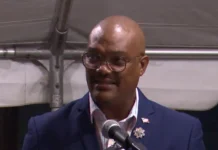
The Premier of Nevis and Leader of Concerned Citizens Movement, Mark Brantley, has taken to his social media account to express his disappointment with the tactics of the opposition, Nevis Reformation Party or the NRP, repeatedly trying to discredit and defame the leader of the NIA.
He expressed his disappointment that the political party (NRP) is repeatedly attacking him and his political party without success.
According to him, the usual practice in marketing is that when the public refuses to buy a product, the response is to change the product or the approach to selling it.
However, in Nevis’s politics, the Nevis Reformation Party keeps telling Nevisian people that “nothing is happening in Nevis”. They say this despite compelling evidence proving them wrong.
According to Mark Brantley, the mantra of the NRP has remained the same in every election. The candidates sing from the same hymn book, saying that nothing is happening in Nevis and (his political party) is terrible for Nevis.
In his opinion, Every one of them spends vast amounts of time fixating on Mark Brantley.
He stated that is the product that the NRP is selling. But is the Nevisian public buying?
In his post, Premier Brantley stated that the record would show that in the last 30 years, the NRP won a single election in 2006. He claimed that we know that win was full of widespread fraud. However, he did not debate it.
He put it in other words, stating that Nevisian voters rejected the NRP product in local elections in 1992, 1997, 2001, *2011 (Fox in the Cox Box), 2013 and 2017. In Federal elections,
Nevisian voters further rejected the NRP in 1993, 1995, 2000, 2004, *2007 (bi-elections), 2010, 2015, 2020 and 2022.
Therefore, between 1992-2022, 14 elections were held. The NRP has “won” one, and the CCM has won 13 In 14 general elections. CCM also won the bi-election in the year 2007.
Premier Brantley further asserted that in the Federal elections of 2020 and 2022, the Nevis Reformation Party did not win any seats from Nevis.
Therefore, Premier Brantley opined that it would be fair to conclude that the Nevisian public has repeatedly rejected the NRP product.
Meanwhile, the political party changed their leaders from Sir Simeon Daniel to Joseph Parry to Elhansville Hector to Dr Kelvin Daly to Dr Janice Hodge. They have changed candidates as well.
Premier of Nevis stated that the NRP had tried several leaders in his constituency, including Hensley Daniel, Hector, Daley and Pat. The people of Nevis rejected all these leaders.
And yet, Premier Brantley lamented, the narrative for the NRP remains unchanged. The candidates (of the political party) of various ages and genders and the party leaders say the same things.
The Premier expressed that their platform remains the same, and so does the product. Ye And time and time and time again, the people of Nevis have rejected the NRP.
However, The Premier stated that the beautiful thing about politics is that people get the opportunity to choose the leader they believe can serve them best in every election.
He insisted that the public is the one who examines and weighs and ultimately determines the winner and the loser. So if the people of Nevis have decided over three decades (30 years) that they prefer the Concerned Citizens Movement, they must believe that the NRP product is not good and that the CCM performance plans and ideas are good and must continue.
He reiterated that, After all, the people have the final say, and their voice is considered the voice of God.
Finally, Premier Brantley stated that he hopes the vacuous noises from the NRP continue during the next cycle of elections and the Nevisian people once again choose substance, solid plans and the stellar performance of the CCM over the noise of the NRP.
He believes that the people of Nevis understand the difference between froth and mauby.

Anthony Morris covers stories related to politics and regional developments. His in-depth reporting about governance and reforms makes him stand out in regional journalism, with a deep analysis of political trends and their impact on Caribbean communities.