



Last Updated on March 20, 2024, 12:39 PM AST by Anthony Morris
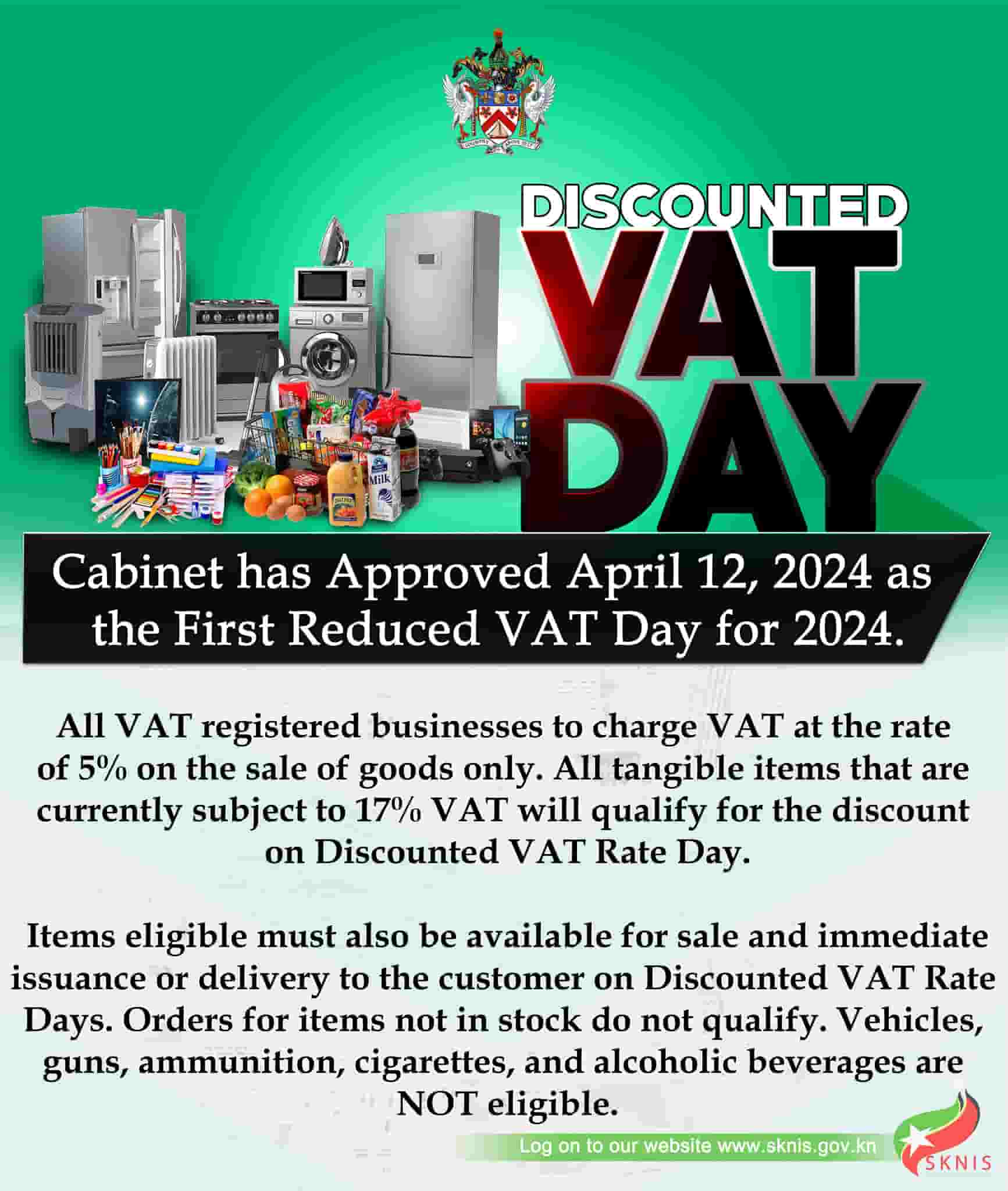
St Kitts and Nevis:- The Cabinet has approved April 12, 2024, as the First Reduced Vat Day 2024. The registered business will charge VAT at the rate of 5% on the sale of goods only. All tangible items covered under 17% VAT will qualify for the discount on the discounted VAT rate day.
The eligible items must also be available for sale and immediate issuance or delivery to the customer on Discounted VAT Rate days. Items that are not in stock do not qualify.
Discounted VAT Rate will not be imposed on vehicles, guns, ammunition, cigarettes and alcoholic beverages.
Taxation in St Kitts and Nevis:-
Few agencies and websites advertise St Kitts and Nevis as a zero-tax country. This is not true. However, citizens and companies can achieve zero taxation. The country does have certain kinds of taxes, which depend on income.
Businesses in St Kitts and Nevis have helped the country boost its economy and foster socio-cultural relationships.
Value Added Tax (VAT) in St Kitts and Nevis:-
Items or goods for which the VAT rate is 17% will be discounted on VAT Rate Day. On 12 April 2024, the rate of 5% VAT will be imposed on such goods.
However, the VAT rate are as follows:-
- The standard VAT rate is 17%.
- A preferential rate of 10% applies to the tourism and hospitality industry
- Stamp duty is payable at various rates for real estate transactions
- VAT-exempt goods include sugar, meat, fish, rice, milk, flour, medical supplies and medications
- VAT is not charged on rent, real estate sales, or financial service.
INDIVIDUAL TAXATION IN ST KITTS AND NEVIS:-
- Tax residents and non-tax residents are given different treatment in the country
- Neither residents nor non-residents are required to pay taxes on inherited money.
- Tax residents do not have to pay taxes on dividends or royalties
- However, non-residents have to pay taxes on dividends or royalties at the rate of 15%
- Individuals who are employed are required to pay a 5% tax on their earnings
Taxation for businesses:-
- The business registered in St Kitts and Nevis is the resident organization.
- Resident companies have to pay 33% of the corporate tax.
- Non-resident companies are only required to pay taxes on profits received from inside the country
The property tax:-
- Property owners are required to pay land tax and building tax
- The rate of these items is completely dependent upon the property itself

Anthony Morris covers stories related to politics and regional developments. His in-depth reporting about governance and reforms makes him stand out in regional journalism, with a deep analysis of political trends and their impact on Caribbean communities.