

Last Updated on November 7, 2022, 4:32 AM AST by Anthony Morris
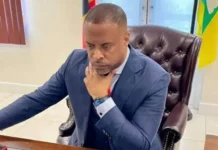
Attorney General Garth Wilkin, who is serving as the minister of justice and legal affairs in the Government of St Kitts and Nevis, expressed his delight in witnessing the New Norm in the National Assembly of St Kitts and Nevis, which includes:
- Respect for each member
- Application of the rules
- Collaboration across the aisle in the event of a necessary and sensible succinct debate
According to attorney general Wilkin, In the past, the National Assembly was a place of long-winded grandstanding, self-serving ego-stroking and persistent abuse.
He elaborated that Parliament comprises the King (represented by the Governor-General) and the National Assembly. In our parliamentary democracy, the Executive (led by the Prime Minister and Cabinet of Ministers) derives its democratic legitimacy from its ability to command the confidence of the Parliament, to which it is accountable.
As the Executive administers the day-to-day business of Government, it decides which laws are necessary to run Government efficiently and effectively. Therefore, the Cabinet recommends most of the laws be tabled in the National Assembly for debate and enactment.
In the detailed Facebook post shared by Minister of Justice, Garth Wilkin following the session of the national assembly, Minister Garth Wilkins stated:
Yesterday in the National Assembly, four bills originating from the Executive were tabled. Each one of them received the open support of opposition members. An opposition leader even seconded one of the bills, a rare event.
Consequently, Minister Garth Wilkins stated that this proved that we are maturing as a democracy. In this democracy, the Representatives of the People have come to the National Assembly to do the People’s work. They are not simply opposing laws for opposing sake and using the National Assembly solely to campaign against the Executive.

Another example of maturity we saw yesterday was the democratic thwarting of an attempt by one opposition member to breach the rules of the National Assembly blatantly. Here, Minister Garth Wilkins was referring to the former Prime Minister of the federation, Dr Timothy Harris, who had gotten into a debate with Cabinet Minister Konris Maynard.
Attorney General Garth Wilkin explained in the update that after the leaders raised a valid objection with submissions in support, both members were allowed to make their case, the Speaker reasoned. Maturity also means that the rule-breaking of the past must end.
According to the Order Paper in the National Assembly, any member can give a “personal explanation”. The Bible for Parliamentary procedures, the Erskine May, states that:

“A Member…may with the leave of the House make a short factual statement of a personal character, such as a personal apology, a correction of information given in a speech made by them in the House or a reply to allegations made against them in the House. The members of the Parliament made Personal statements only in connection with matters of substance.
They are usually taken at the beginning of public business and are not debatable.”
The members of the national assembly should condemn any misuse of this procedure to grandstand.
Minister Garth Wilkins believes that in the unicameral Parliament of St Kitts and Nevis, where Representatives and Senators sit in the National Assembly together to vote on laws and do other business, it is even more critical that we respect its work and procedures.
The New Norm of our National Assembly is a welcomed change to our Nation. He believes that leaders must work on preserving it as an example to our young people.
This new maturity in our highest court isn’t by accident. It is a purposeful policy of those members sitting on the Speaker’s right, given the great shows of maturity of most of those members sitting on the Speaker’s left yesterday. He concluded his Facebook post, hoping it is a New Day and a Better Way for our National Assembly.

Anthony Morris covers stories related to politics and regional developments. His in-depth reporting about governance and reforms makes him stand out in regional journalism, with a deep analysis of political trends and their impact on Caribbean communities.