
Last Updated on May 18, 2021, 6:19 AM AST by Anthony Morris
Basseterre: Jonel Powell, Minister of Education, Youth, Culture and Sport, emphasizes the need for UNESCO and developed countries to assist small island developing states in calibrating education for sustainable development (ESD) in curricular structures, with regard to social, economic and political context of small island communities.
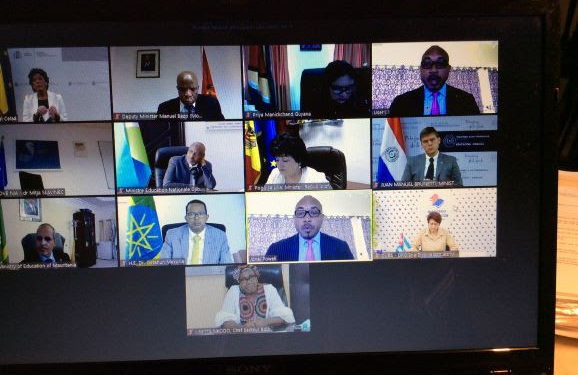
The Minister was one of more than fifty Ministers of Education invited on 17 May to virtually address the UNESCO World Conference ESD 2021 at a special Ministerial Roundtable on the Implementation of ESD for 2030. The conference was hosted in collaboration with the Federal Ministry of Education and Research of Germany, and with the German Commission for UNESCO as Advisory Partner, and attended by ministers, officials and experts of the UNESCO Member State, UNESCO, the OECD and the UN family of organizations.
Minister Powell states that the government of St. Kitts and Nevis continue to “strongly endorse the shared vision and responsibility of the UNESCO countries related to ESD, with respect to the community’s respect for life, ecological integrity, social and economic justice and democracy, non-violence and peace.”
“As we struggle with the consequences of the Covid pandemic, striking inequality, divergent economic development, ecological decline, social instability, these fundamental principles have never been so important. These concerns have particular repercussions for developing countries on small islands, as we in turn seek to strengthen sustainable environmental, social and economic development.”
The head of the Federation’s education strategy since 2017, Minister Powell said, is the provision of “holistic and lifelong education for all, which contributes to sustainable development, the building of civic responsibility and the promotion of individuals’ ability to live locally and globally.”
Although the national educational curriculum has been continuously reoriented to reflect this ESD focus, “Our challenge now is to explore further how to best integrate ESD as part of the horizontal and vertical curriculum components in our national education program.”
He noted that two areas stand out for special attention in the integration of ESD as part of cross-curriculum learning and architecture:
Sustainability by examining the long-term impact of social, cultural, scientific, technological, economic practices on society and the environment. Small islands prone to natural disasters, economic innovation in the light of the remote environment, isolation and size, and the preservation of national cultural heritage all fall into this category.
Citizenship – examine what it means to be a citizen and contribute to society’s development and well-being. The rise of gang culture, with young men having a sense of marginalization and leaving formal education prematurely, is a critical factor that can be addressed through the teaching of citizenship.
But, Minister Powell concluded, “But we can not do it ourselves. The institutional capacity on our islands is limited and the pool of ESD-talented mentors is small.”
He called on the international community to get in touch with the small islands in the Caribbean and, critically, with UNESCO, to help restructure the national educational curriculum to achieve the optimal balance between horizontal ESD and to achieve vertical primary curricular components.
Minister Powell’s speech at the UNESCO ESD ministerial event was facilitated by the Federation’s permanent delegate to UNESCO in Paris, Ambassador David Doyle, who remarked: “I think the message resounded that a dedicated SIDS ESD framework is needed to address the specificity of small islands. Furthermore, empirical research on sustainable development in SIDS tends to be limited and the educational implications of sustainable development are thoroughly addressed, as it applies to small island communities.”

Anthony Morris covers stories related to politics and regional developments. His in-depth reporting about governance and reforms makes him stand out in regional journalism, with a deep analysis of political trends and their impact on Caribbean communities.