





Last Updated on January 18, 2020, 2:06 PM AST by Anthony Morris
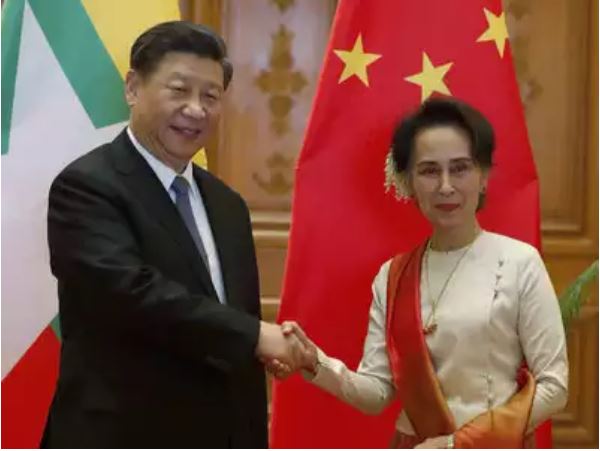
China and Myanmar on Saturday inked 33 deals planned for accelerating key foundation undertakings to give Beijing a venturing stone to the Indian Ocean after a gathering between President Xi Jinping and State Counselor Aung San Suu Kyi, as the Communist country increase backing to solidify its hold over the Southeast Asian nation enduring an onslaught for its treatment of Rohingya Muslims.
Holding converses with Xi on the last day of his two-day visit, Suu Kyi hammered the western nations for reprimanding Myanmar over the treatment of the Rohingya issue.
Over 7.3 lakh Rohingya Muslims fled to neighbouring Bangladesh claiming assaults by the Myanmar armed force, setting off a worldwide displaced person emergency.
Xi and Suu Kyi consented to 33 arrangements, covering zones, for example, legislative issues, exchange, speculation and individuals to-individuals interchanges, supporting mammoth undertakings that are a piece of the leader Belt and Road Initiative (BRI), China’s vision of new exchange courses portrayed as a “21st-century silk street”.
Myanmar might want to advance the structure of the Myanmar-China Economic Corridor and upgrade participation in transport, vitality, generation limit, philanthropic and social trades, fringe zones and local issues, Suu Kyi told Xi during the discussions.
A few nations plan to meddle in the personal undertakings of different countries with so many reasons as human rights, ethnicities and religions, and Myanmar will never acknowledge such impedance, she said.
Suu Kyi said Myanmar trusted China would keep on keeping up equity for the centre and little nations including Myanmar, state-run China Daily revealed.
The fundamental focal point of the understandings marked after the discussions between the two chiefs gave off an impression of being on the execution of the China Myanmar Economic Corridor (CMEC) which is much the same as the $60 billion-dollar China-Pakistan Economic Corridor (CPEC) under which China hopes to get to Pakistan’s Gwadar port in the Arabian ocean.
CMEC is additionally a goliath availability venture connecting landlocked southwestern China to the Indian Ocean.
Subtleties on understandings came to over CMEC were scrappy, yet they purportedly remembered a concession and investors understanding for the $1.3 billion Kyaukhphyu remote ocean port and monetary zone.
Kyaukhphyu ventures concern India as they give a venturing stone to China to the Indian Ocean.
Other than Gwadar, China additionally obtained the Hambantota port raising worries over the hypothesis of “String Pearls” to enclose India by Beijing.
There was additionally a letter of purpose for “new urban improvement” in Myanmar’s most magnificent city Yangon and achievability reads for rail joins.
China, which for a considerable length of time had kept up close ties with the Myanmar military in any event, when Suu Kyi was detained for quite a long time, has again become a significant partner in fighting off worldwide seclusion of Nay Pyi Taw in the wake of the Rohingya emergency.
In his discussions with Suu Kyi, Xi said the two nations should accelerate interfacing advancement systems.
Absent from his discussions was the Bangladesh, China, India, Myanmar (BCIM) passage which China in the past overwhelmingly proposed yet clearly dropped it over India’s tepid help.
India has been severely condemning of the BRI as CPEC, which goes through Pakistan-involved Kashmir (PoK) is its leader venture.
Doubt develops over Beijing’s impact.
Boundless doubt of Beijing’s impact in the nation perseveres among the individuals who are suspicious the monetary advantages will stream down to the majority and of binds to revolt bunches battling the state in fringe zones.
“They accept that China has been exploiting,” said Thu Wai, pioneer of the Democratic Party, one of the 17 ideological groups who came to Naypyidaw as a feature of the visit.
The absence of straightforwardness encompassing the 33 arrangements will prompt a “reaction” as question develops, said political expert Khin Zaw Win.
That outrage was in plain view in Yangon, where many dissidents revitalized against any restoration of a questionable Chinese-upheld super dam.
They held signs calling for “end” of the $3.6 billion Myitsone venture, which was not referenced in the marked arrangements.

Anthony Morris covers stories related to politics and regional developments. His in-depth reporting about governance and reforms makes him stand out in regional journalism, with a deep analysis of political trends and their impact on Caribbean communities.