



Last Updated on May 28, 2024, 5:53 AM AST by Anthony Morris
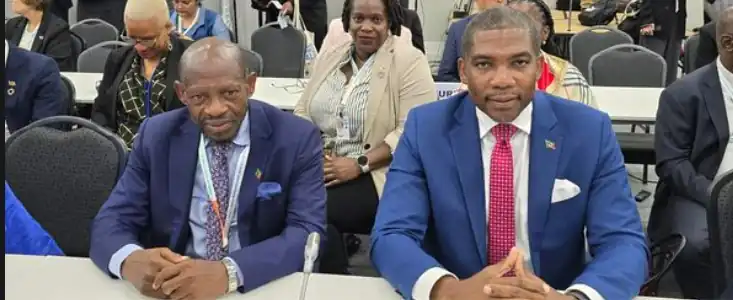
Prime Minister Dr Terrance Drew participated in a high-level event on the Caribbean-EU Partnership. The event was hosted on the sidelines of the 4th International Conference on Small Island Developing States (SIDS) in Antigua and Barbuda.
PM Terrance Drew was greeted upon his arrival by Ambassador to the Association of Caribbean States (ACS), Clarence Pilgrim. He was also joined at the airport by the Prime Minister of Dominica, Dr. Roosevelt Skerrit.

PM Terrance Drew accompanied several delegates, including Dr. Denzil Llewellyn Douglas, Minister of Foreign Affairs, International Trade, and Dr Joyelle Clarke, Minister of Environment et al. to Antigua and Barbuda.
Gaston Browne, Prime Minister of Antigua and Barbuda gave the St Kitts and Nevis delegation a warm welcome.
“This important event seeks to strengthen the Caribbean-EU partnership and enhance its progress and visibility in the framework of the Caribbean Regional Protocol of the Somoa Agreement, promoting engagement with key EU investors,” highlights the PM.
The Secretary-General of the United States, Antonio Guteress, welcomed President Dr Muhamed Muizzu to the opening ceremony of SIDS4.
Pennelope Beckles, Minister of Planning and Development of Trinidad and Tobago, was also graciously received by Dennis Francis, the President of the General Assembly.
PM Dr. Terrance Drew joined the event and delivered an address at the beginning of the 4th International Conference on Small Island Developing States.
He spotlighted how small island developing states can undertake the journey towards prosperity.
He believes it is important to appreciate that prosperity is negotiating an obstacle course. Turbulence in the world due to extreme environmental conditions, conflicts, supply chain disruptions, and several other risks has made the course more difficult, not to mention capital constraints and high inflation and unemployment rates.
Though it sounds like a movie script of a dystopian genre, this is what these fragile micro-states have to deal with if life is to become worth living for their citizens and if there is to be hope in a world filled with increasing uncertainty. What we have done so far shows the strength of island communities worldwide, adds PM Terrance Drew.
He also thinks that the time has now arrived when building resilience to secure SIDS from the impact of external shocks has become necessary.
To do so, PM Drew has suggested some critical elements necessary for the development and prosperity of SIDS.
- Available, accessible, and adequate cost: Small Island Developing States need cheaper capital, which is still too expensive for their fiscal capacity. The Bridgetown Initiative clearly calls for reforming the international financial architecture. On another matter, PM Terrance Drew extended his congratulations to Prime Minister Gaston Brown for his outstanding work on the High-Level Panel of the United Nations in promoting the Multidimensional Vulnerability Index to expand the concept of economic well-being beyond Gross Domestic Product.
- Technology: It is making a new group of global leaders who use it for innovation, improving government and business to promote fairness and economic progress. Prime Minister links technology to education and highlighted, in his address that the youngsters coming from SIDS to master the technology that defines social and economic activity.
- Infrastructure: Resilient infrastructure, especially in the domains of water, energy, and climate-smart hospitals, is one such investment. Climate change could cut Caribbean crop yields by 10-20% by 2050. To build resilient health systems, SIDS must strengthen food systems, and that’s why CARICOM’s 25×25 initiative is so important.
- Health is a crucial condition for the prosperity of any community. For that reason alone, as CARICOM’s Lead Prime Minister on health, a physician, and a critical citizen, the requirement to underline perhaps the most significant connecting factor—namely, that the climate crisis is intensifying many diseases, such as dengue and Lyme disease—cannot be emphasized strongly enough. Severe weather events, such as Hurricane Maria in Puerto Rico back in 2017, can potently disrupt health facilities, leading to poor outcomes or even death.
- Severe weather, increasing in frequency in all SIDS, threatens our development aspirations. Added to this are the high rates of chronic diseases in the Caribbean, setting the stage for disaster.
“We, the children of the world’s nation-states, have come together in pursuit of prosperity for SIDS; we must not let it escape us,” concludes Prime Minister Dr. Terrance Drew.
On 29 May 2024, St Kitts and Nevis will host its national side event at the Fourth International Conference on Small Island Developing States under the theme “Towards Sustainable Island States: Tackling Human Capital and Health Crises in the Caribbean.
Minister Joyelle Clarke who was also a part of the Prime Minister’s delegation stated that St Kitts and Nevis is very excited to have collaborated with The University of the West Indies, the premier educational institution in the region.
Joyelle Clarke, through her ministry of environment has been advocating for sustainable development of the country on several regional and international platforms.
The ministers have shared their ideas about building resilience in the health system, health and human capital, and the impact of the climate crisis on current and future generations.

Anthony Morris covers stories related to politics and regional developments. His in-depth reporting about governance and reforms makes him stand out in regional journalism, with a deep analysis of political trends and their impact on Caribbean communities.