

Last Updated on December 21, 2020, 10:13 AM AST by Chris Matthew
Guyana: President Muhammad Irfan Ali feels that the ruling International Court of Justice (ICJ) this morning should be observed by all the people of Guyana and should be seen as a healing point for the country.
The chairman and other officials were at the Arthur Chung Conference Center to look into the landmark decision by the ICJ that it has jurisdiction to hear Guyana’s case relating to the 1899 arbitration award establishing a war boundary between Guyana and Venezuela.
When the announcement was made on visual monitors, a jubilant explosion began to echo around the site and President Ali immediately called and thanked the lawyers who had represented Guyana.
The President said that it was a privilege for me to talk to Sir Srinath, but he said that the victory was one which took hard work and dedication from many people over the years.
“I want this morning to get ahead of our lawyers and our legal team, I want to thank all those who played such an integral part of the process, many who have many names, many of whom are in this room.”
President Ali pointed out that despite political differences the governments of Guyana have remained steadfast in their desire to protect our sovereignty and resolve to protect our territorial integrity.
“We have always stood together, we have always identified together, and demonstrated together to the international community that we are one and we are united on our sovereignty and borders.”
The President said that the ruling was a great victory for Guyana and should be used to unify the country going forward.
“This victory is a testimony to what we can achieve as a person when we are united and it should be a healing point for our country, there is no compromise on our sovereignty, we can simultaneously Huh. And it is with this feeling that I think we should be together on the development and future of our country. ”
The president thanked the United Nations for choosing the court to resolve the case and hoped that Venezuela, which had opted not to participate, would reconsider its decision.
“I now express hope that the court has ruled decisively in favor of the judicial fields to rule on the merits that our neighbors would consider fully participating in the proceedings.”
Foreign Minister, Hon. Hugh Todd also called the regime a victory for Guyana. He said it was also a victory for multilateralism, indicating that Guyana prefers to be on the right side of the law.
The minister said that although Guyana respects the people of Venezuela, it is imperative that Guyana protect its territorial integrity and sovereignty.
Despite the ruling, the minister said there was still much to be done, but believed the end of the process was in sight.
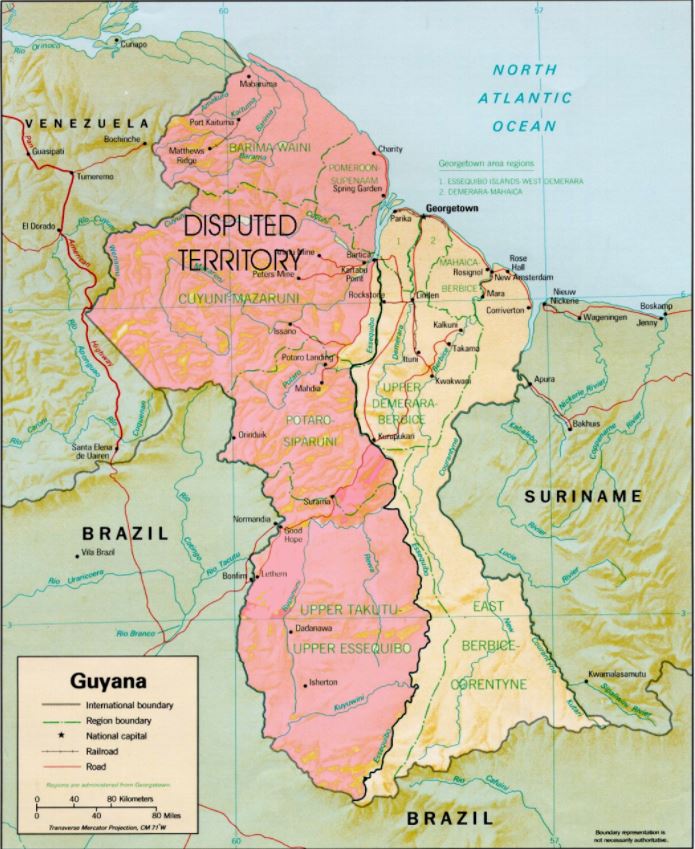
The land border between Guyana and Venezuela has been disputed since the colonial establishment between the British and Spanish powers in South America.
In the 1840s, the British government conducted a unilateral survey of the border, but the proposed line was an encroachment of Venezuela’s territorial claims.
The border has since been agreed to after mediation (1899) and bilaterally demarcated (1905), but remains in conflict. While the British line, which has been accepted by Guyana, is the current de facto border, Venezuela currently holds a historical claim for all territories administered by Guyana west of the Esseedibo River.
The de facto border follows a series of rivers, watersheds, and other geographic features for a distance of 829 kilometers from the Atlantic coast, which travels with Brazil over Mount Rorima. Venezuela’s claim on the banks of the Essedibo River stretches for 1,034 kilometers before reaching the Brazilian territory.
At stake is approximately 142,795 square kilometers, currently administered by Guyana. The maritime area of the disputed land area is the maritime location that was recently discovered to be rich in hydrocarbon resources, which promotes stakes of land border disputes.
Guyana presented the dispute to the International Court of Justice in 2018. Despite Venezuela withdrawing from the case, proceedings are still ongoing.

Chris Matthew is a well-seasoned expert in feature writing, with a strong focus on covering international updates.. He blends his creative thinking with a journalistic mindset to report on events and issues across the world with precision and accuracy.