





Last Updated on September 6, 2020, 7:22 AM AST by Anthony Morris
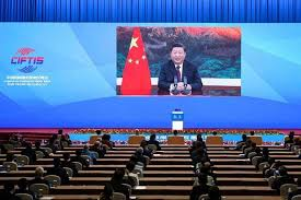
China’s President Xi Jinping has pledged to open service industries of China more comprehensive to the foreign competitors as the first in-person trade fair of the country since the coronavirus outbreak.
He gave no details in his speech Friday night, but Chinese leaders are emphasizing the development of retailing, tourism and other services.
These are part of a campaign to nurture China’s economic growth which is driven by consumer spending instead of investment and exports.
China will “actively expand imports of high-quality services,” and “relax market access for service industries,” the Chinese President said at the China International Fair for Trade in Services.
He appeared on a video screen before the Chinese businesspeople and a handful of foreign VIPs who were wearing masks and sitting in widely spaced chairs at a convention centre adjacent to the site of the 2008 Summer Olympics.
Most of the exhibitors from abroad participated via the internet because Beijing has yet to relax the bar on most foreign visitors from the country.
The annual export-oriented Canton Trade Fair of southern China was held online in June.
China’s manufacturers are efficient global competitors, flexible, but its fledgeling finance, tourism, health care and other service industries lag their Western counterparts.
However, regulatory barriers limit the ability of foreign banks as well as other providers to compete in China even two decades after Beijing joined the free-trading World Trade Organization.
US officials who have waged a tariff war with China over its trade record point to services, in which the US runs a surplus with China, as a promising area.
Organizers have said that 18,000 companies and 100,000 people from 148 countries and regions had signed up to take part in the trade fair.
China, where the COVD-19 pandemic began in December, was the first economy to shut down and the first to begin the struggle to revive business after the ruling party declared victory over the disease in March.

Anthony Morris covers stories related to politics and regional developments. His in-depth reporting about governance and reforms makes him stand out in regional journalism, with a deep analysis of political trends and their impact on Caribbean communities.