





Last Updated on March 27, 2024, 12:29 PM AST by Anthony Morris
St Kitts and Nevis: Dr Joyelle Clarke, Minister of Environment, Climate Action, and Constituency Empowerment, announced the ban on single-use plastics in an official statement made on 26 March 2024 in the National Assembly.
This is a pivotal move by the government of St Kitts and Nevis to preserve the environment and advance sustainable development.
Reportedly, Senator Clarke said that the government had introduced the ban on single-use plastics before implementing the Environmental Protection Bill 2024, also known as the Restriction on Single-use plastic bill. Adding an effect to solidify the federation’s environmental conservation policies.
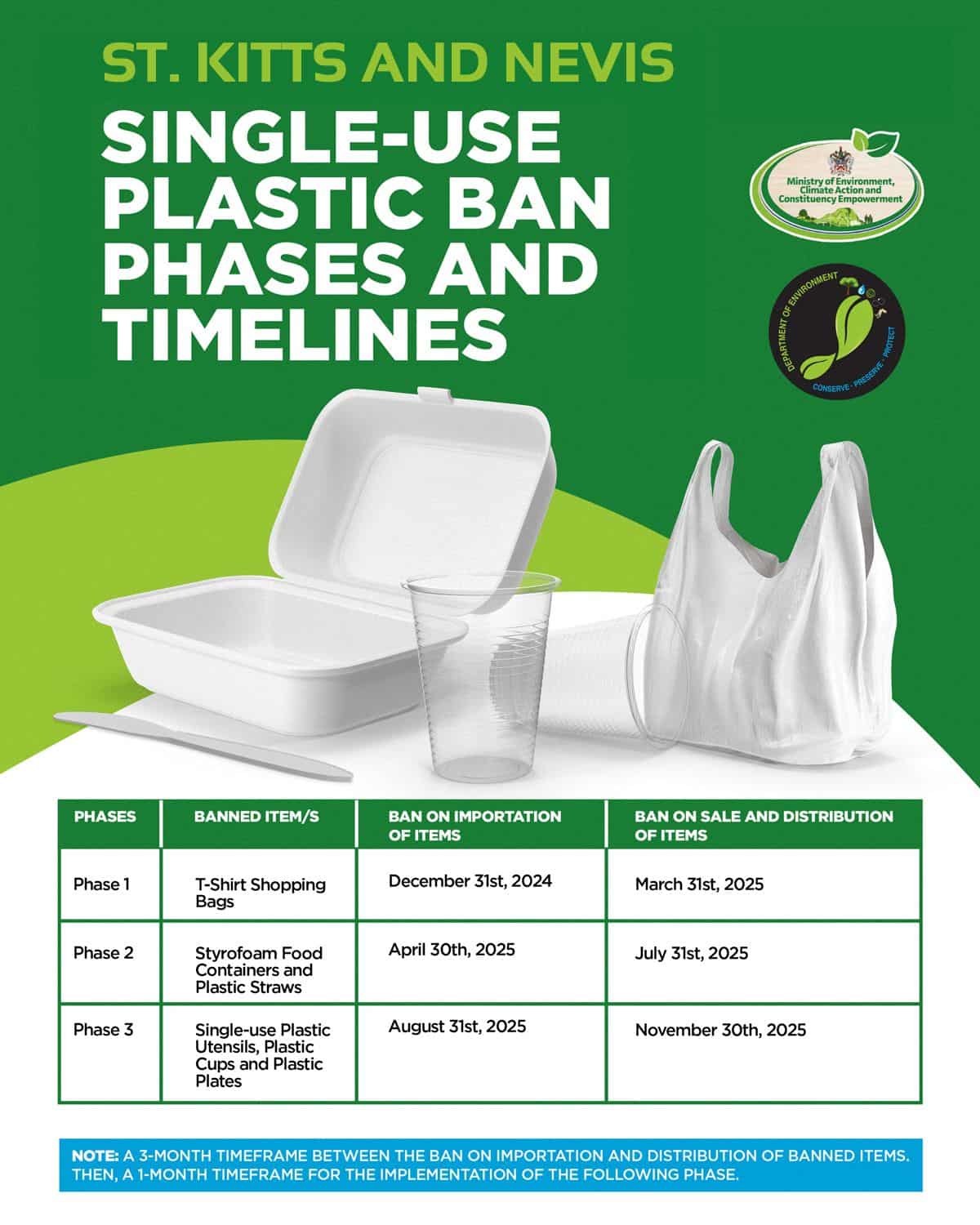
The ban will be carried out in three stages:-
- Targeting the importation
- Sale
- Distribution of specific single-use plastic products
The federal government will introduce different phases to implement the policy efficiently.
- The first phase will start on 31st December 2024, introducing the ban on importing T-shirt plastic shopping bags.
- The sale and distribution of t-shirts and plastic shopping bags will be prohibited by 31st March 2025.
- The second phase will prohibit the import of Styrofoam food containers and plastic straws by 30th April 2025.
- The sale and distribution of Styrofoam food containers and plastic straws will be prohibited by 31st July 2025.
- The final phase will introduce the ban on importing single-use plastic cups, plates and utensils by 31st August 2025.
- The sale and distribution of plastic cups, utensils and plates will be by 30 November 2025.
Following this, similar actions were taken by other Caribbean countries, such as Saint Lucia, Antigua and Barbuda, the Bahamas, Barbados, Belize, the Dominican Republic, Grenada, Guyana, Jamaica, St Eustatius, and Trinidad and Tobago.
Dr Clarke stated, “ I am compelled to remind every Kittian and Nevisian that every small action collectively, creates major movements in recycling, upcycling, and limiting the use of plastics.” The small changes today will lead to incremental improvements in human and environmental health”.
The landmark decision taken by the federal government on the national assembly fits with the United Nations sustainable development goals, which include good health and well-being, clean water and sanitation, sustainable cities and communities, responsible consumption and production, climate action, and life below water and on land.
This initiative makes St Kitts and Nevis one of those 100 developing countries implementing a full or partial ban on single-use plastics.

Anthony Morris covers stories related to politics and regional developments. His in-depth reporting about governance and reforms makes him stand out in regional journalism, with a deep analysis of political trends and their impact on Caribbean communities.