


Last Updated on October 23, 2019, 10:20 PM AST by Anthony Morris
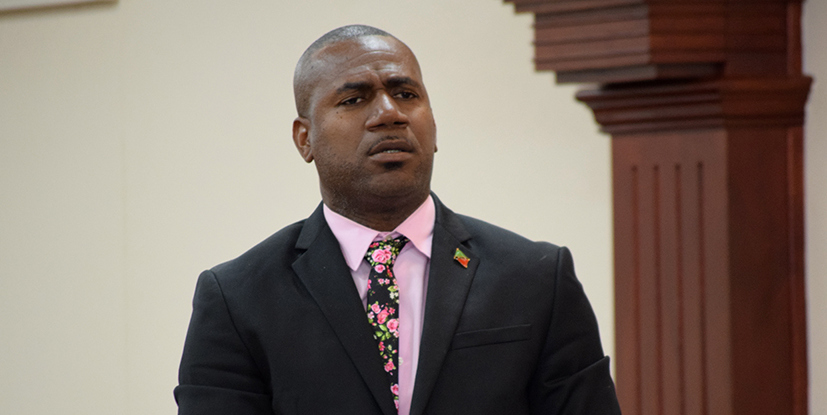
Deputy Prime Minister and Minister of Education, Hon Shawn Richards has exposed the lies and deception of Prime Minister Dr the Hon Timothy Harris on the matter of the federation’s debt to GDP ratio at the end of 2014.
Over the years, Dr Harris, as prime minister and minister of finance, has never truthfully told the nation during his press conferences, in the National Assembly, in discussions with visiting diplomats and officials, what the Debt to GDP of St Kitts and Nevis was when he took office in February 2015.
Dr Harris on most occasions has always quoted that it was “149 percent of GDP in 2010,” but never disclosed the debt to GDP figures for the succeeding years, between 2011 and 2014.
Addressing the St. Kitts-Nevis Chamber of Industry & Commerce’s (CIC) Annual Private Sector Banquet to mark its 70th anniversary on October 19, 2019, Richards said data from the Ministry of Finance indicates that the Federation’s debt to GDP ratio in June 2014 was 85 percent.
The International Monetary Fund (IMF) Country Report on St Kitts and Nevis (No 15/248) dated September 2015 reported that “the debt-to-GDP ratio declined to 79 percent of GDP at end-2014, compared to a forecast of 86.2 percent in the last program review, and 100.8 percent at end-2013.”
“The bulk of the decline was achieved through restructuring of central government and public sector enterprises domestic debt, equivalent to 34.6 percent of 2014 GDP (or 43 percent of 2010 GDP) to the indigenous banking system. This took place through debt-land swap operations in July 2013, and August and October 2014. Bilateral agreements with all Paris Club creditors have been signed relating to the May 2012 agreement on debt equivalent to 0.8 percent of GDP, yielding some debt forgiveness by one creditor and rescheduling by another. Discussions with non-Paris club creditors, namely Kuwait, Taiwan ROC and Venezuela have also advanced. In addition, the authorities concluded a debt exchange with bondholders and commercial external creditors with more favorable coupon rates in mid April 2012. In 2014, early repayments to the Fund equivalent to 2.6 percent of GDP further accelerated the decline in outstanding debt. There was also an advance repayment to the SSB of 2.2 percent of GDP and to the Development Bank of St. Kitts and Nevis of 0.9 percent of GDP in August 2014,” the IMF reported.
Operator Rescue’s Dwyer Astaphan blasted Prime Minister Harris for taking credit for bringing the Federation’s debt-to-GDP ratio in line with the international benchmark of 60 percent and for not keeping his promise to undo the land for debt swap initiative.
Astaphan pointed out that the debt to GDP was about 74 percent by December 2014, two months before the February 2015 elections.
He said the dramatic decrease in the Debt to GDP ratio came about as a result of several initiatives including new arrangements with creditors and the Land for Debt Swap, an initiative which Dr. Harris, then a senior minister in the Labour Government headed by Denzil Douglas vehemently opposed.
“It was a sore point that the then government member, Dr. Harris, stood in the parliament one evening opposing his colleagues on the passage of that particular piece of legislation to introduce the land for debt swap,” said Astaphan, who recalls Harris’ words, ‘If I perish, I perish.’
“He was dead set against the land for debt swap,” said Astaphan, who quickly added: “It is this very land for debt swap which was the single major factor in dramatically dropping the debt to GDP ratio and the national debt.”
Astaphan asked: “If the land for debt swap was bad in 2013, if the manifesto of Team Unity says in the clearest of language that the swap was bad, and that on taking office, would reverse it, why is it not reversed yet?”

Anthony Morris covers stories related to politics and regional developments. His in-depth reporting about governance and reforms makes him stand out in regional journalism, with a deep analysis of political trends and their impact on Caribbean communities.