
Last Updated on June 10, 2020, 5:31 AM AST by Anthony Morris
The killing of George Floyd in America, an African American man who had died due to asphyxiation after a white police officer had consistently pressed on his neck in Minneapolis, Minnesota, on May 25, has become the catalyst for putting the concerns of the Black Lives Matter (BLM) movement back on the front.
BLM’s mandate to campaign against the violence and systemic anti-black racism which manifests dangerously in acts of police brutality have inspired similar protests around the world.
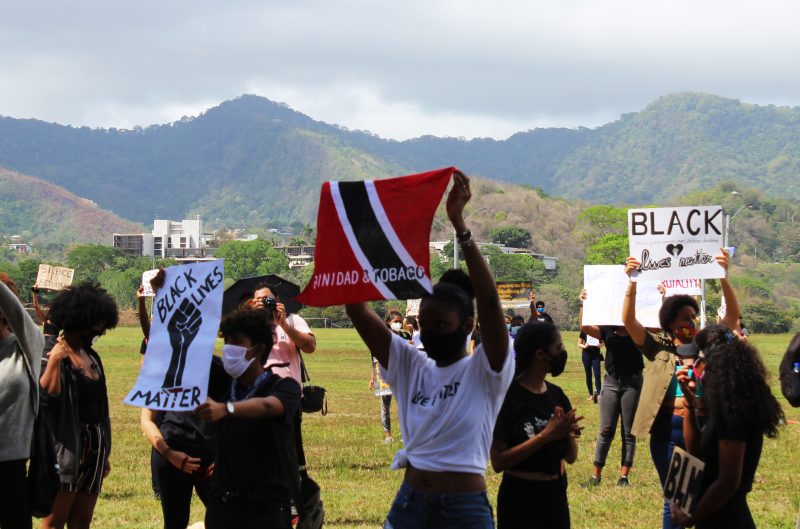
On June 8, more than 500 people joined in solidarity with #BlackLivesMatter by demonstrating in front of the United States Embassy in Port of Spain. It was the second public protest on the issue in four days, with this one reportedly being more heated than its predecessor. However, certain segments of society remained antagonistic toward the cause.
“No justice, no peace,” were the words echoed as protestors assembled in the Queen’s Park Savannah. Drivers passing along the perimeter of the city’s main green space held their hands in fists out of cars, sounded their horns, and shouted the slogan “Black Lives Matter” in solidarity not only with African Americans but also in acknowledgement of the deep-seated racism still festering under the surface of Trinidad and Tobago’s multicultural society.
While there were altercations with the police, mainly over lack of consent with regard to an officer filming protestors, the protest was peaceful and harmonious overall. For the most part, protestors practised proper social distancing protocols, which were further enforced by the police present.
US Ambassador Joseph Mondello spent some time talking with protestors. He commended everyone who turned out for their message — and for wearing masks and practising safe social distancing.
In the wake of Floyd’s death, discussions about race have dominated social media in Trinidad, and Tobago, fuelled by insensitive remarks made by business owners like Gerald Aboud, whose Facebook comments telling black people to change their mindset were widely deemed racist.

Anthony Morris covers stories related to politics and regional developments. His in-depth reporting about governance and reforms makes him stand out in regional journalism, with a deep analysis of political trends and their impact on Caribbean communities.