






Last Updated on May 22, 2026, 5:47 AM AST by Anthony Morris
CS Global Partners launched the fifth edition of the World Citizenship Report on May 21, 2026. The report is a unique endeavour within the global migration industry, which looks at Citizenship through the lens of the global minded individual.
In 2026, the world is largely defined by geopolitical instability with Economic divergence, geopolitical fragmentation, and shifting regulatory frameworks. All these aspects significantly affect the way the global citizens look at security, opportunity and mobility.
In light of the current state of affairs in the greater world, with different growth trajectories across different regions, disruptions in supply chains, emergence of new centres of conflict in addition to the conflicts which have existed previously, the global minded citizens are not being confronted a singular threat but a general atmosphere of uncertainty.
Citizenship through the lens of the Global Minded Individual
In light of the world situation, the World Citizenship Report uses a data-driven framework to look at evolving priorities oof the global minded individuals. The report does not depend upon any conventional measures of citizenship attractiveness. Instead, the report sees how global citizens see various jurisdictions in terms of the stability they can offer.
The report explores how citizens also look at the economic potential, quality of life, and financial autonomy that a given country offers while making decisions to move to or away from a particular country. The theme for this Year’s World Citizenship Report is: The New Normal: Citizenship in an age of Perpetual Uncertainty.
The Five Core Motivators
The World Citizenship Report 2026 evaluates Citizenship across five core motivators:
- Safety and Security
- Economic Opportunity
- Quality of Life
- Global Mobility
- Financial Freedom
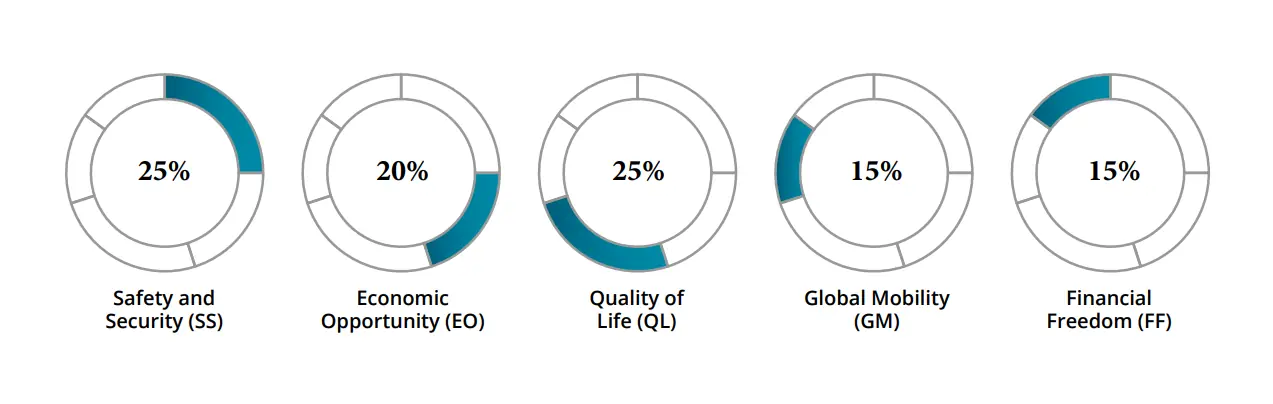
The five pillars of motivation are assigned weightage on the basis of the importance that the respondents give that aspect while making mobility decisions. Every nation which is evaluated as a part of the World Citizenship Report is scored out of 100 in each motivator or pillar.
Then, a weighted aggregate is taken with all the scores in consideration, which then gives out the final score for the various countries being reviewed.
World Citizenship Index from the lens of Global Citizens
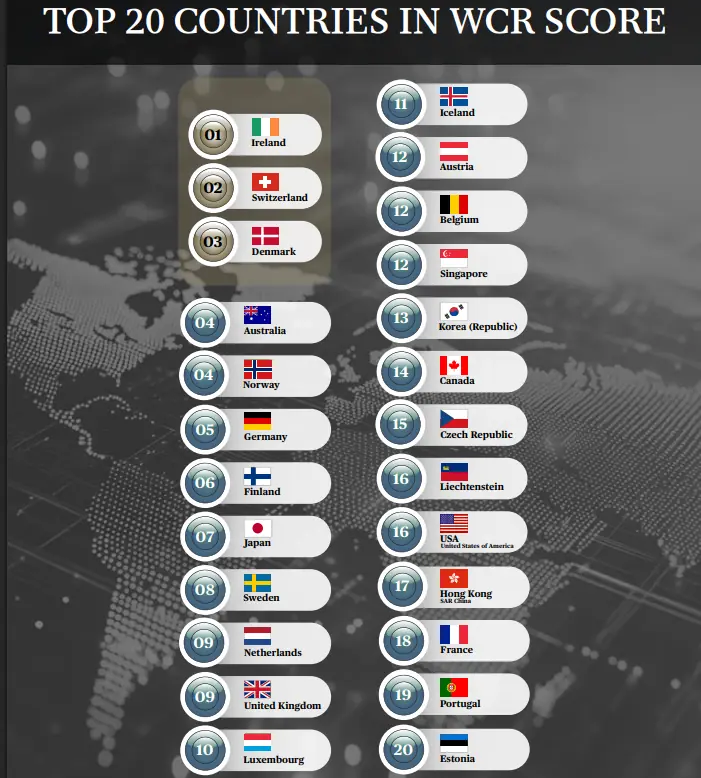
Ireland has reclaimed the top spot in the World Citizenship Index after slipping to the 7th slot in the 2025 edition of the report. The nation has ranked in the top five within the Global Mobility, Safety and Security as well as the Economic Opportunity Motivator.
The nation which topped the 2025 Index, Switzerland, has dropped to the second spot, having continued to perform well in the safety and security and the quality-of-life motivators.
The World Citizenship Index is dominated significantly by the European Countries as eighteen nations from the continent found themselves placed in the top 20 rankings of the World Citizenship Report. Several nations tied with other nations for the same ranks within the top 20.
Asia has also seen significant growth, with China, Singapore and Korea (Republic) also placed in the Top 20 ranks, with powerful global economies like the United States of America.
The World Citizenship Index has seen a shuffle in its rankings compared to the previous years. The United Kingdom, which ranked in the 12th place in 2025, climbed to the 9th rank in the 2026 edition of the WCR.
Similarly, the United States of America, which ranked 19th last year, has climbed 3 spots to land on the 16th place in the WCI.
Five Core Pillars of Motivation of WCR: A detailed look
The Quality-of-Life Pillar has once again emerged as the most valuable pillar of the World Citizenship Index with a weightage of 25%. Quality of Life continues to dominate the minds of the HNWIs when making decisions about moving into or away from nations
Germany, with a score of 90.2 is dominant in Quality of Life followed by Norway, Switzerland, Finland and Sweden making the top five. The European states are ranked so highly due to their strong healthcare systems, environment standards and strong social infrastructure.
Quality of Life ranks as the single most important feature of citizenship for HNWIs at 27.3%. Afterwards, the mass affluent individuals are known to look for better financial, business or career opportunities with 18.9% weightage and and greater freedom of movement at 18.7%.
The Safety and Security Pillar was dominated by Iceland, Switzerland, and Denmark. The pillar ranks nations on the basis of presence of strong institutions, rule of law, and low crime rates.
Several European nations have experienced some decline in this pillar rankings even though the top nations have remained stable. The experts believe that Safety and Security remain extremely important for Citizenship related decision making.
When thinking of the benefits of Second Citizenship, the HNWIs are likely to prioritise family security and generational protection first and foremost. Emergency or contingency planning comes after along with protection of Asset and estate the considerations of factors such as education and healthcare come into consideration next.
The third pillar the World Citizenship Index, Economic Opportunity is led by China, United States of America and Ireland in that order of ranking. The nations who are not in any of the international economic rankings across the globe can be seen featured in the WCR.
The pillar looks at growth trajectory, structural reforms, and forward-looking potential alongside established economic strength. The people continue to priotitise asset relocation and opportunity. The pillar is the third most important motivator with 20% weightage. This reinforces that while economic opportunity is crucial, it does not outweigh family security and quality of life.
The next pillar, Global Mobility is dominated by Asian nations with Singapore leading the 2026 Global Mobility rankings at 91.0. Japan and the Republic of Korea rank at number 2. Denmark also features in the top tier with several other leading European countries.
The index rankings are heavily based on visa agreements which evolve rapidly. The HNWIs prioritise ease of mobility along with better opportunities for their businesses. In an increasingly unpredictable world, the high-net-worth individuals continue to look for flexibility in terms of movement.
Singapore leads the 2026 Financial Freedom rankings with Denmark and Finland in second and third places. Switzerland and Norway round off the top five. The nations have been ranked high for their regulatory transparency, institutional stability, and open financial systems.
The 2026 World Citizenship Report is seeing a structural shift in how citizenship is defined and utilised by the HNWIs. Citizenship is a very important part of the long-term planning for a more interconnected less predictable world.
The HNWIs continue to look for flexibility in the nations that they want to move to with the aim of diversifying risk, navigating uncertainty, and continuing to work towards opportunities and outcomes.
The 2026 World Citizenship Report highlights that modern global stability requires active planning across multiple nations instead of relying on a single sovereign state.

Anthony Morris covers stories related to politics and regional developments. His in-depth reporting about governance and reforms makes him stand out in regional journalism, with a deep analysis of political trends and their impact on Caribbean communities.