





Last Updated on October 19, 2026, 7:46 AM AST by Anthony Morris
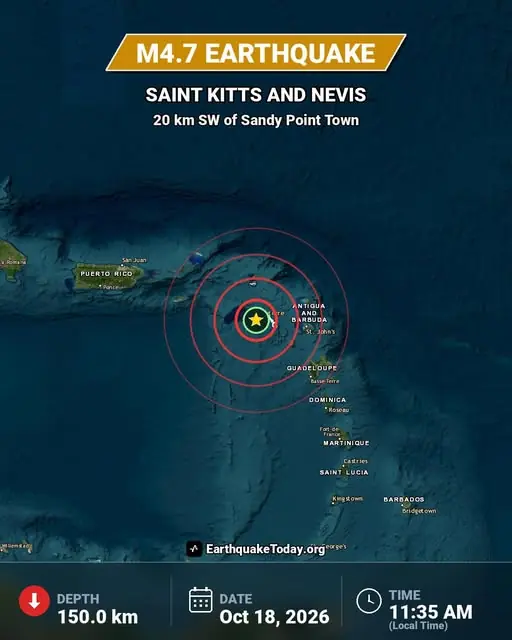
Sandy Point Town in St. Kitts and Nevis experienced a 4.7 magnitude in the late morning hours of the day on October 18, 2026. The officials have shared that the earthquake struck at approximately 11:35 AM at the event.
The officials have shared that the earthquake did not cause any significant damage to property in the affected area. The epicenter of the earthquake was estimated to be at exactly 93.2 miles in the southwest region of the Sandy Point Town. The earthquake hit the sea which reduced the intensity of the earthquake before it reached the landmasses.
The officials have shared that the earthquake hit the sea at a depth of 150 kilometers. The event was measured in the Modified Mercalli Intensity Scale which has a scale featuring 12 levels.
As per this scale, the 4.7-magnitude earthquake has been classified as an Intensity III event which means that the affected area experienced Weak Shaking around the land masses. The people may have felt the intensity of the The officials have shared that the earthquake mainly hit at sea and thus the chances of a tsunami being caused in the aftermath of the earthquake were extremely low.
The officials have confirmed that the earthquake has occurred within the known subduction zones wherein the internal North American plate is actively driving its way beneath the Caribbean plate.
The Caribbean region has been experiencing several small earthquake events, especially in the previous few months. The officials have shared that the recent earthquake events are happening in a very disproportionate manner. Over the last several months, these events have taken place not only around St. Kitts and Nevis but also around the Caribbean region,
The experts from across the region have called this a consequence of Caribbean Plate adjusting with environmental changes such as heavy regional stress and subducting grinding plates.

Anthony Morris covers stories related to politics and regional developments. His in-depth reporting about governance and reforms makes him stand out in regional journalism, with a deep analysis of political trends and their impact on Caribbean communities.